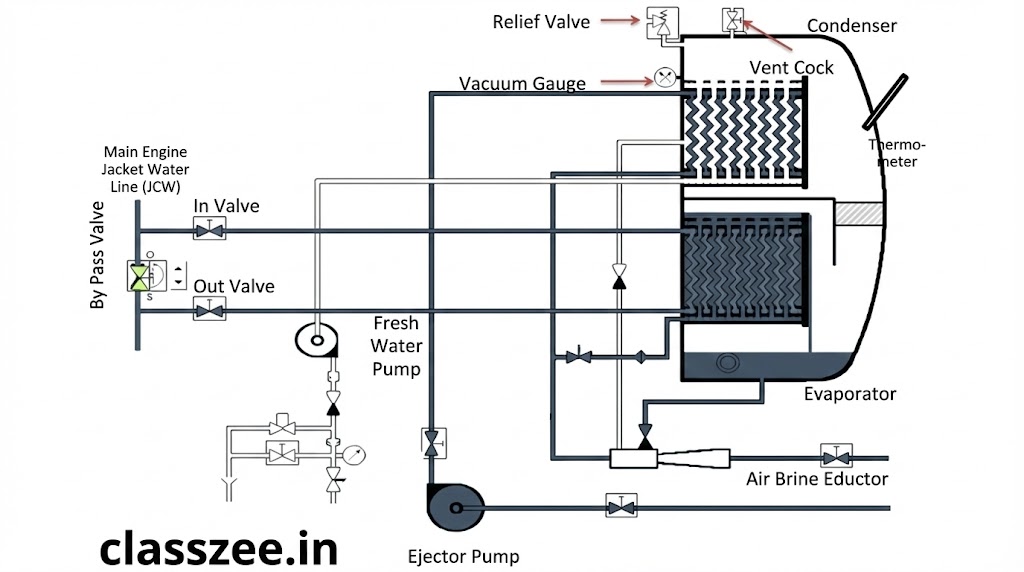
What is Fresh Water Generator (FWG)?
A Fresh Water Generator (FWG) is an auxiliary machinery used on ships to convert seawater into fresh water by the process of vacuum distillation.
1. Basic Working Principle of Fresh Water Generator (FWG)
The Fresh Water Generator (FWG) works on the principle that the boiling point of water decreases as pressure decreases. By creating a vacuum inside the shell, seawater boils at a much lower temperature (Around 40°C to 50°C) using waste heat from the Main Engine Jacket Cooling Water (JCW).
- Heat Source: Main Engine Jacket Cooling Water (approx. 75°C - 80°C).
- Cooling Medium: Seawater.
- Operating Pressure: High Vacuum (approx. 90-95%).
2. Main Components & Construction
A standard Plate-Type or Shell-and-Tube Fresh Water Generator consists of the following key parts:
| Component | Function | Material |
|---|---|---|
| Evaporator | Heats seawater using JCW to produce steam. | Titanium Plates / Al-Brass Tubes |
| Condenser | Cools steam back into distilled water using seawater. | Titanium Plates / Al-Brass Tubes |
| Demister | Prevents carry-over of salt droplets into the distillate. | Monel Metal / Stainless Steel mesh |
| Ejector | Creates vacuum and removes brine/air. | Bronze / Stainless Steel |
| Salinometer | Monitors salinity (PPM) of the produced water. | Electronic Sensor |
| Distillate Pump | Extracts fresh water from the condenser to the tank. | Centrifugal Pump |
3. Step-by-Step Working Procedure of Fresh Water Generator (FWG)
How does a Fresh Water Generator (FWG) work?
FWG works on the principle that the boiling point of water decreases under vacuum.
Seawater evaporates at about 40–50°C using waste heat from Main Engine Jacket
Cooling Water
and is then condensed to produce fresh water.
- Vacuum Creation: Ejector creates vacuum inside the FWG shell.
- Feed Water Entry: Seawater enters the evaporator chamber.
- Heating: JCW heats seawater causing evaporation at low temperature.
- Demister: Removes salt droplets from vapor.
- Condensation: Vapor is cooled and converted into fresh water.
- Extraction: Fresh water is pumped to tanks after salinometer check.
4. Why is Vacuum Required?
Vacuum is essential for two main reasons:
- Low-Temperature Boiling: It allows water to boil at 40-50°C. If we boiled water at 100°C, the scale formation on plates would be rapid and hard to remove.
- Energy Efficiency: It utilizes waste heat from the engine rather than requiring a dedicated boiler or heater.
🛠️ Maintenance Tips: Scale Removal
- Chemical Cleaning: Descaling chemicals (usually weak acids) are circulated to remove hard scales (Calcium Carbonate/Magnesium Hydroxide).
- Mechanical Cleaning: For shell and tube types, rod cleaning is done. For plate types, plates are dismantled and scrubbed with soft brushes.
- Note: Never use steel wire brushes on Titanium plates as it damages the protective oxide layer.
What is Fresh Water Generator (FWG)?
Fresh Water Generator is an auxiliary machinery on ships used to produce fresh water from seawater for drinking, domestic use, and boiler feed.
What is Fresh Water Generator and how does it work?
FWG converts seawater into fresh water by evaporation and condensation under vacuum using waste heat from main engine jacket cooling water.
What is the working principle of Fresh Water Generator in ship?
FWG works on the principle that the boiling point of water decreases when pressure decreases (vacuum distillation).
What is the principle of Fresh Water Generator?
The principle of FWG is vacuum distillation, where seawater boils at low temperature and is then condensed into fresh water.
What is plate type Fresh Water Generator?
Plate type FWG uses thin plates for evaporation and condensation, providing higher efficiency and compact design compared to shell type.
Why is chemical cleaning done in Fresh Water Generator?
Chemical cleaning is done to remove scale, salt deposits, and marine growth from plates to maintain proper heat transfer and efficiency.
Which chemical is used for FWG chemical cleaning?
Mild acidic chemicals approved by the manufacturer are used to remove scale without damaging titanium plates.