Marine Heat Exchangers: Types, Working & Maintenance Guide
🚀 Key Highlights
Function: Transfer heat between two fluids.
Types: Shell & Tube vs. Plate Type.
Main Use: Cooling Fresh Water, Lube Oil, Jacket Water.
Maintenance: Crucial to prevent overheating.
1. What is a Heat Exchanger?
A Marine Heat Exchanger is a piece of machinery used to transfer heat from one medium to another without the two media mixing. On ships, the primary purpose is to cool down hot fluids (like Main Engine Jacket Water or Lube Oil) using cooler sea water.
This ensures the main engine and auxiliary engines operate within safe temperature limits, preventing overheating and mechanical failure.
2. Shell and Tube Heat Exchanger
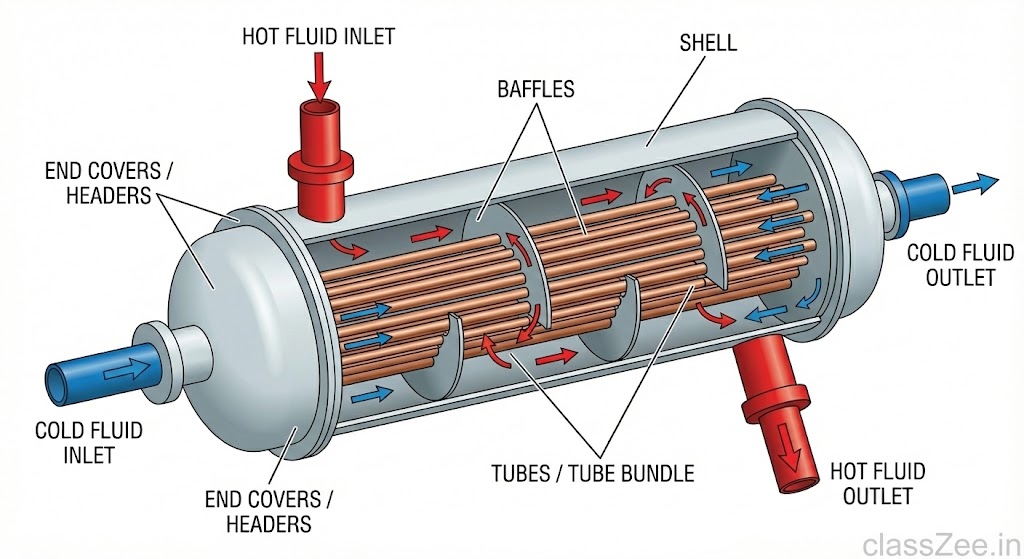
This is the most traditional type found on ships. It consists of a large cylindrical shell with a bundle of tubes inside it.
Working Principle:
- One fluid (usually sea water) flows through the tubes.
- The other fluid (hot oil or fresh water) flows over the tubes inside the shell.
- Baffles are used to direct the flow and increase turbulence for better heat transfer.
Pros: Robust, can handle high pressures.
Cons: Less efficient per square meter compared to PHE, difficult to clean manually.
3. Plate Heat Exchanger (PHE)
Modern ships extensively use Plate Heat Exchangers. They consist of a series of thin, corrugated metal plates compressed together in a frame.
[Image of Plate Heat Exchanger diagram]Advantages:
- High Efficiency: Large surface area in a small volume.
- Easy Maintenance: Can be opened easily for cleaning.
- Expandable: Capacity can be increased by adding more plates.
However, gaskets in PHEs are prone to leakage if not tightened correctly.
4. Maintenance & Cleaning
Proper maintenance ensures the efficiency of the heat exchanger. Common methods include:
Back Flushing
Reversing the flow of water to dislodge loose debris, mud, or marine growth (like barnacles) blocking the tubes or plates.
Chemical Cleaning (CIP)
Cleaning In Place (CIP) involves circulating a chemical solution to dissolve scale and deposits without dismantling the unit.
Manual Cleaning
For Shell & Tube: Using rods to clear tubes.
For PHE: Opening the stack and scrubbing plates with a soft brush (never use wire brushes on PHE plates).
5. Common Problems
| Problem | Cause | Solution |
|---|---|---|
| Reduced Cooling | Fouling / Scale formation | Clean plates/tubes, check sea strainer |
| Leakage | Damaged Gaskets or O-rings | Replace gaskets, tighten bolts |
| Corrosion | Electrolytic action | Check Zinc Anodes |