What are Marine Centrifugal Pumps?
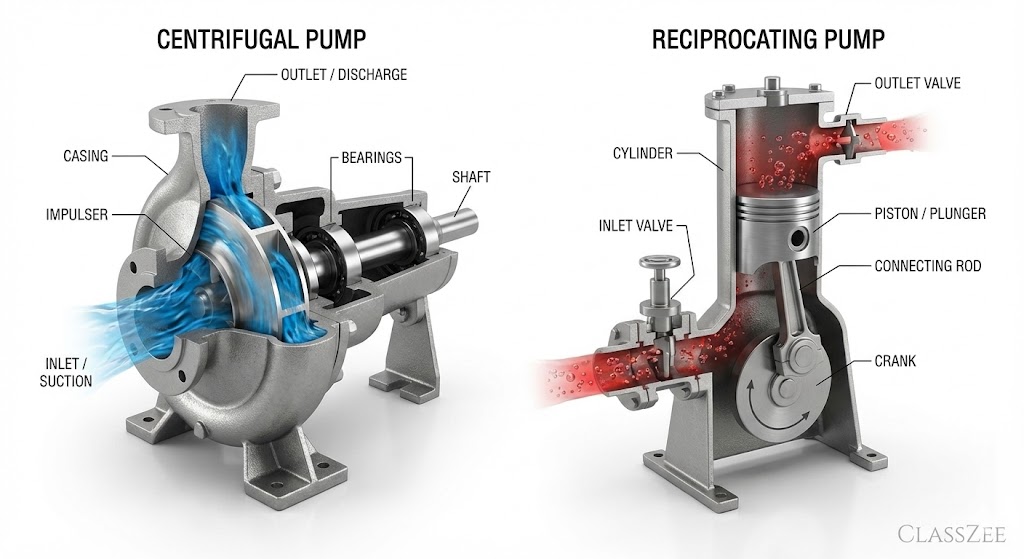
Pumps are used on ships to transfer fluids from one location to another by increasing their pressure energy. The two most common types found in the engine room are Centrifugal Pumps (Roto-dynamic) and Reciprocating Pumps (Positive Displacement).
1. Basic Working Principle of Pumps
Understanding the core difference in how these pumps move fluid is essential for any marine engineer. Centrifugal pumps use rotational kinetic energy to move fluid, while Reciprocating pumps trap a fixed amount of fluid and force it into the discharge pipe.
- Centrifugal Action: Uses an impeller to throw liquid outwards, creating kinetic energy that converts to pressure.
- Reciprocating Action: Uses a piston or plunger moving back and forth to physically displace liquid.
- Flow Characteristic: Centrifugal gives continuous flow; Reciprocating gives pulsating flow.
2. Key Differences (Comparison Table)
Here is a detailed comparison between Centrifugal and Reciprocating pumps relevant for MEO Class 4 exams:
| Parameter | Centrifugal Pump | Reciprocating Pump |
|---|---|---|
| Working Principle | Roto-dynamic (Kinetic Energy) | Positive Displacement |
| Flow Type | Continuous and Smooth | Pulsating and Intermittent |
| Viscosity | Suitable for Low Viscosity (Water) | Suitable for High Viscosity (Oil/Sludge) |
| Priming | Requires Priming (Not Self-Priming) | Self-Priming |
| Construction | Simple, fewer moving parts | Complex, more moving parts (Valves) |
| Discharge Valve Closed | Safe for short time (Churning) | Dangerous (Relief Valve will lift) |
3. Marine Applications & Usage
Where do we use which pump on a ship?
The choice depends on the fluid properties and the required pressure/flow rate.
Centrifugal pumps are used for high flow, low viscosity fluids.
Reciprocating pumps are used for high pressure, high viscosity, or precise dosing.
- Sea Water Pump (Main Cooling): Centrifugal (High flow required).
- Bilge Pump: Reciprocating (Self-priming ability needed).
- Fire Pump: Centrifugal (High volume delivery).
- Sludge Pump: Reciprocating (Handles thick, viscous fluids).
- Boiler Feed Pump: Multi-stage Centrifugal (High pressure).
- Fuel Oil Transfer: Gear/Screw (Positive Displacement) or Reciprocating.
4. Suction Lift & Priming
One of the most critical operational differences is the ability to lift water from a low level (suction lift).
- Centrifugal Pumps: They cannot handle air. If air enters the casing, the pump becomes air-locked and stops pumping. They require an external priming system (like an ejector or vacuum pump) to remove air and fill the casing with water.
- Reciprocating Pumps: They are Self-Priming. Because the piston physically pushes air out, they can create a vacuum in the suction line and lift liquid from the bilge or double bottom tanks without external help.
🛠️ Maintenance Tips & Advantages
- Centrifugal Maintenance: Easier to maintain due to fewer parts. Main issues are mechanical seal leaks and wear ring clearance.
- Reciprocating Maintenance: Requires frequent attention to suction/discharge valves, piston rings, and gland packing.
- Safety Note: Never start a reciprocating pump with the discharge valve closed. Always check the relief valve setting.
What is the main difference between centrifugal and reciprocating pumps?
Centrifugal pumps use rotational energy for continuous flow (good for water), while Reciprocating pumps use a piston for pulsating flow (good for high viscosity oils and sludge).
Why is a centrifugal pump not self-priming?
Because it cannot pump air. If the impeller casing is full of air, the centrifugal force generated is too weak to create the vacuum needed to suck water up the pipe.
Why is a relief valve fitted on a reciprocating pump?
Since it is a positive displacement pump, it will keep building pressure if the discharge is closed. A relief valve is essential to prevent pipe bursting or motor damage.
Can we use a centrifugal pump for sludge transfer?
No, it is not efficient. High viscosity fluids like sludge cause excessive friction in the impeller, drastically reducing efficiency. A positive displacement pump is required.
Which pump is used for the Emergency Fire Pump?
Usually a Centrifugal pump, but it must be fitted with a self-priming device (like an attached vacuum pump) to ensure it can lift water quickly during an emergency.
What is 'churning' in a centrifugal pump?
Churning occurs when the discharge valve is closed while the pump is running. The water spins inside the casing, heating up due to friction, which can damage the pump seal.
Why are bilge pumps usually reciprocating type?
Bilge wells often contain air pockets and are located at the bottom of the ship. The self-priming ability and strong suction lift of reciprocating pumps make them ideal for stripping bilges dry.