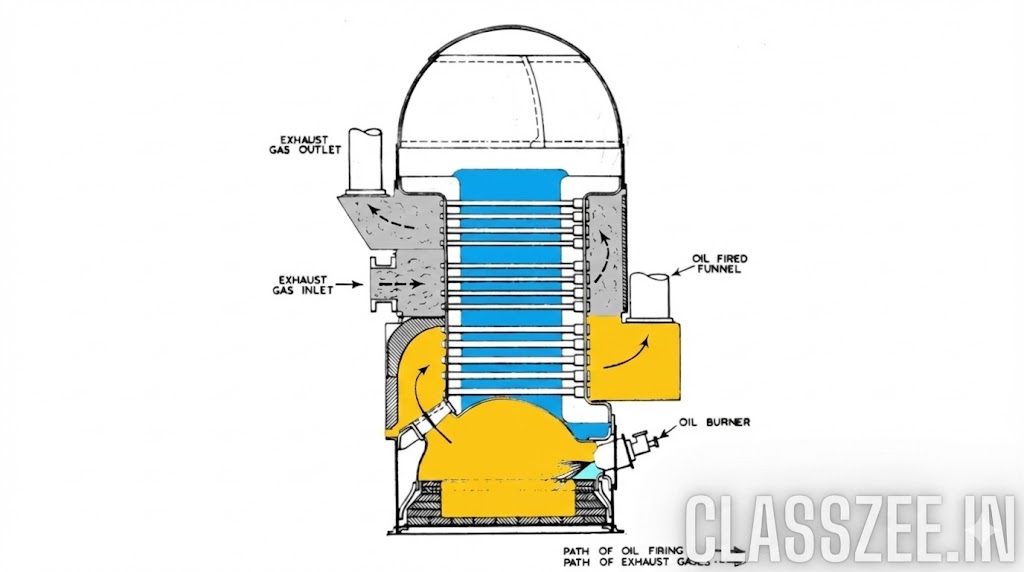
What is a Marine Boiler?
A Marine Boiler is a closed pressure vessel used on ships to generate steam by heating water. This steam is essential for heating heavy fuel oil (bunker), driving cargo pumps on tankers, and sometimes for main propulsion (in steam ships).
1. Basic Working Principle of Marine Boiler
The boiler works on the principle of heat transfer. Fuel is burned in a furnace to produce hot gases. These hot gases transfer their heat energy to the water surrounding tubes or inside tubes. As the water temperature rises above its boiling point, it converts into high-pressure steam.
- Radiation: Heat transfers from the flame directly to the furnace walls.
- Convection: Heat transfers as hot gases flow over the tubes.
- Conduction: Heat passes through the metal thickness of the tubes to the water.
2. Main Components & Mountings
A boiler must have specific fittings (mountings) for safety and operation. Here are the key components:
| Component | Function | Material |
|---|---|---|
| Safety Valve | Releases excess pressure to prevent explosion. | Cast Steel / Bronze |
| Gauge Glass | Shows the visible water level inside the boiler. | Toughened Glass |
| Main Steam Stop Valve | Controls the supply of steam to the ship's systems. | Cast Steel |
| Feed Check Valve | Controls the entry of feed water into the boiler. | Stainless Steel |
| Blowdown Valve | Used to empty the boiler or remove sludge/sediments. | Forged Steel |
| Air Vent | Releases air during filling and prevents vacuum when cooling. | Bronze / Steel |
3. Step-by-Step Steam Generation
How does a Boiler generate steam?
The process involves combustion, heat transfer, and steam separation. On most cargo ships, an "Auxiliary Boiler"
is used for port operations, and an "Exhaust Gas Economizer" (Composite Boiler) is used at sea.
- Combustion: The burner atomizes fuel and mixes it with air to create a flame in the furnace.
- Circulation: In water-tube boilers, density difference causes water to circulate naturally.
- Evaporation: Water turns into wet steam as it absorbs latent heat.
- Separation: The steam drum separates water droplets from steam (using cyclones/scrubbers).
- Superheating: (Optional) Wet steam is heated further to become dry superheated steam.
- Distribution: Steam is sent to heaters, calorifiers, and turbines.
4. Types of Marine Boilers
There are two main designs used in the merchant navy based on the path of water and fire:
- Fire Tube (Smoke Tube) Boiler: Hot gases pass inside the tubes, and water surrounds them. Example: Cochran Boiler. Simple, robust, but low pressure limit.
- Water Tube Boiler: Water flows inside the tubes, and hot gases surround them. Example: Babcock & Wilcox. Generates high-pressure steam quickly, used for propulsion.
🛠️ Maintenance Tips: Water Treatment
- pH Control: Boiler water must be alkaline (pH 9-11) to prevent acidic corrosion.
- Oxygen Scavenging: Chemicals like Hydrazine are added to remove dissolved oxygen which causes pitting.
- Blowdown: Regular "scum" blowdown (surface) removes oil/foam, and "bottom" blowdown removes heavy sludge.
What is the difference between a water tube and a fire tube boiler?
In a Fire Tube boiler, hot gases pass inside the tubes surrounded by water. In a Water Tube boiler, water flows inside the tubes surrounded by hot gases.
What is a Composite Boiler?
A Composite Boiler can generate steam using two methods: by firing its own oil burner (in port) or by using waste heat from the Main Engine exhaust (at sea).
Why are two safety valves fitted on a boiler?
SOLAS regulations require at least two safety valves to ensure that if one fails or seizes, the other can still release pressure and prevent an explosion.
What is the purpose of the Scum Valve?
The Scum Valve is located near the water surface level. It is used to blow down floating impurities like oil and foam from the boiler water surface.
What is Priming and Foaming?
Priming is the carry-over of water droplets into the steam line (dangerous for turbines). Foaming is the formation of stable bubbles on the water surface, often caused by oil contamination or high alkalinity.
Why is the Gauge Glass considered a critical mounting?
Because running a boiler without water causes overheating and explosion. The gauge glass provides the only direct visual confirmation of the water level inside.
What is the function of the Economizer?
An Economizer is a heat exchanger located in the exhaust uptake. It pre-heats the feed water using waste exhaust gases before it enters the boiler drum, improving efficiency.